 +91 990 880 2225
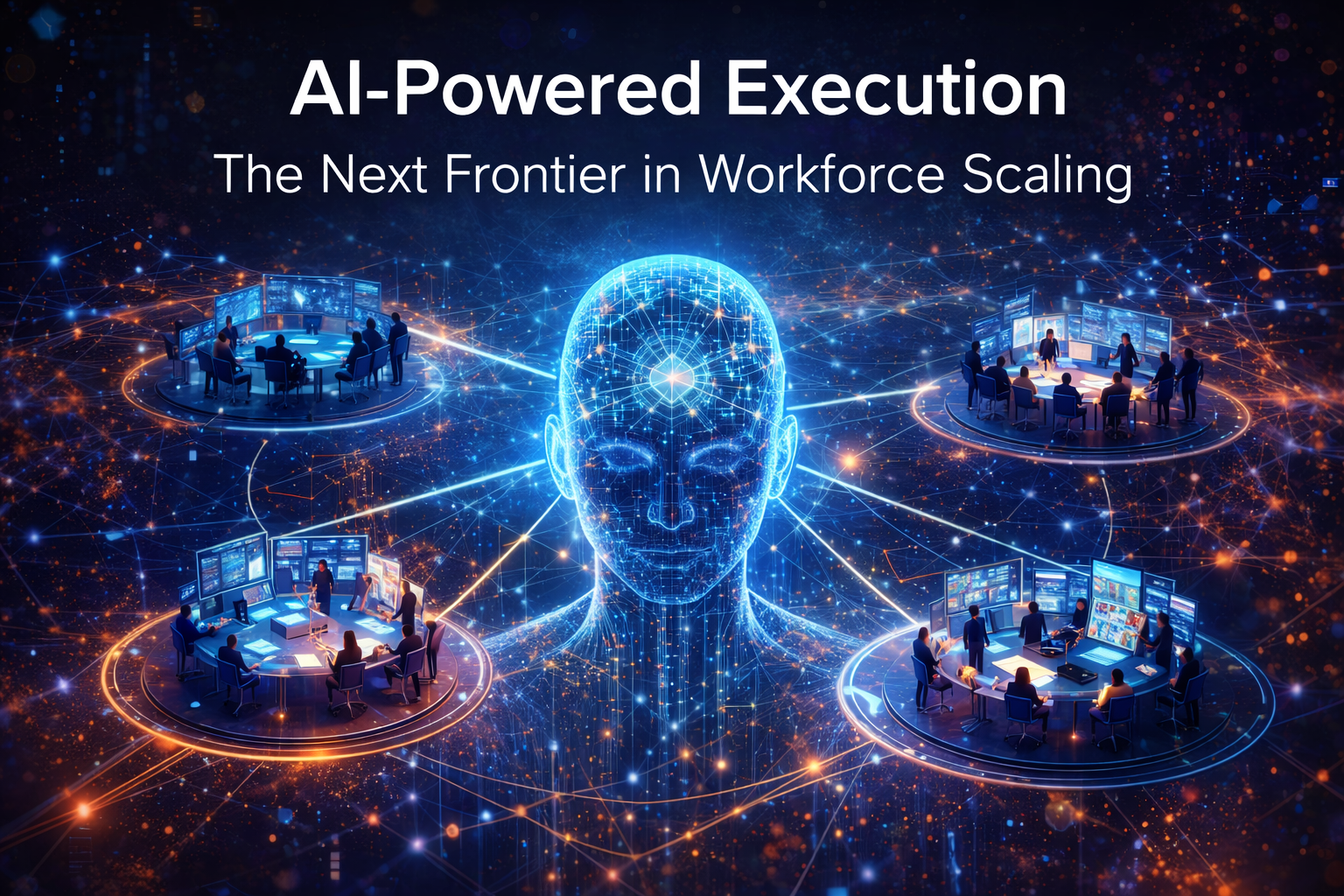
1. We Spent a Century Learning How to Hire. We’re About to Learn How to Execute.
For more than a hundred years, organizations scaled in one primary way:
they hired.
More demand → more people.
More projects → bigger teams.
More ambition → larger org charts.
This model shaped factories, corporations, IT services, and even startups.
It worked because work itself was linear, localized, and slow-moving.
But something fundamental has shifted.
In 2026 and beyond, the constraint is no longer how many people you can hire.
The constraint is how fast you can execute without collapsing under your own structure.
And that is where AI-powered execution begins.
2. Workforce Scaling Is Breaking — Quietly
Most organizations won’t announce that their workforce model is failing.
They’ll just feel it.
Hiring takes longer.
Onboarding delays output.
Teams grow, but velocity doesn’t.
Coordination overhead eats into productive time.
Burn increases without proportional results.
Nothing looks “wrong” on paper.
Headcount grows. Budgets are approved.
But execution slows.
This is the signature of a model that has reached its limit.
Workforce scaling — scaling by adding people — is no longer the fastest way to scale work.
3. The Real Bottleneck Was Never Talent
There is no global shortage of talent.
There is:
-
a shortage of fast coordination
-
a shortage of outcome clarity
-
a shortage of execution orchestration
Highly capable people spend a shocking percentage of their time:
-
waiting for decisions
-
aligning across teams
-
sitting in status meetings
-
navigating approvals
-
redoing work due to miscommunication
This is not a productivity problem.
It is a coordination problem.
And coordination, for the first time in history, is something AI can do better than humans.
4. AI’s Most Important Contribution Isn’t Automation — It’s Orchestration
Most conversations about AI focus on tasks:
-
writing code
-
generating content
-
analyzing data
But that’s not the breakthrough.
The breakthrough is that AI can now orchestrate work itself.
AI can:
-
break large goals into executable outcomes
-
match the right capability to each outcome
-
coordinate contributors in parallel
-
track progress continuously
-
detect bottlenecks early
-
enforce governance consistently
-
close execution loops automatically
This changes the unit of scale.
Instead of scaling people, organizations can now scale execution.
5. From Workforce Scaling to Execution Scaling
This is the conceptual leap leaders must make.
Workforce scaling asks:
-
How many people do we need?
-
How should we organize them?
-
Who manages whom?
Execution scaling asks:
-
What outcomes must be delivered?
-
What capabilities are required?
-
How fast can we assemble and deliver?
The second question is far more powerful — and far more compatible with the modern world.
AI-powered execution allows organizations to scale what gets done, not how many people are employed.
6. Why Org Charts Collapse Under Execution Pressure
Org charts exist to coordinate human effort.
But they rely on:
-
reporting lines
-
managerial oversight
-
scheduled communication
-
hierarchical decision-making
All of these introduce latency.
As execution speed becomes a competitive advantage, latency becomes fatal.
AI removes the need for:
-
manual coordination
-
status reporting
-
middle-layer supervision
This is why AI doesn’t replace humans — it replaces org charts.
Humans still create value.
AI ensures that value flows without friction.
7. Virtual Delivery Centers (VDCs): The Execution Primitive of the AI Era
This is where Virtual Delivery Centers (VDCs) become central — not optional.
A Virtual Delivery Center is an AI-orchestrated execution unit that:
-
assembles global talent on demand
-
integrates AI agents and SaaS tools
-
delivers clearly defined outcomes
-
operates without hiring or hierarchy
-
scales up or down instantly
VDCs are not outsourcing.
They are not freelancing.
They are not staff augmentation.
They are execution-native structures — built for speed, clarity, and scale.
8. What VDCs Replace — Explicitly
VDCs replace:
-
long hiring cycles
-
rigid team structures
-
permanent roles
-
departmental silos
-
employment-based scaling
They replace structure-heavy organizations with outcome-first execution networks.
In a VDC-driven model:
-
outcomes come first
-
contributors are assembled dynamically
-
AI coordinates execution
-
payment is tied to results
This is workforce scaling without workforce expansion.
9. The New Operating Model Emerges
The emerging pattern for high-performing organizations looks like this:
-
A small, strategic core team
-
AI-powered orchestration at the center
-
Multiple VDCs handling execution
-
Contributors instead of employees for most work
-
Outcomes instead of roles as the unit of value
This model is:
-
faster
-
more capital-efficient
-
more resilient
-
globally scalable
And critically — it adapts in real time.
10. Why AI-Powered Execution Wins Economically
From a business perspective, AI-powered execution delivers:
-
Lower fixed costs → more variable capability
-
Higher utilization → less idle time
-
Faster time-to-market → competitive advantage
-
Global access → deeper talent pools
-
Reduced coordination overhead → more real work
Companies stop paying for presence and start paying for performance.
That is a fundamental economic upgrade.
11. Why This Is Pro-Human (Not Anti-Work)
There is a persistent fear that AI-powered execution means fewer humans.
The opposite is true.
AI-powered execution:
-
frees humans from coordination labor
-
removes location and visa barriers
-
allows people to work across multiple outcomes
-
increases earning potential
-
rewards merit over proximity
Humans become contributors, not headcount.
This is not about reducing work.
It is about unlocking participation.
12. The Role of Humans in AI-Powered Execution
In this model:
-
humans define intent
-
humans solve complex problems
-
humans create, design, decide, imagine
AI:
-
coordinates
-
optimizes
-
enforces
-
accelerates
This is a partnership — not a replacement.
The most powerful organizations of the next decade will be human-led and AI-orchestrated.
13. Why 2026 Is the Inflection Year
In 2026:
-
execution speed becomes the primary moat
-
hiring-based scaling lags behind opportunity
-
capital efficiency matters more than size
-
adaptability beats stability
Organizations that cling to workforce scaling will feel heavier each quarter.
Organizations that adopt AI-powered execution will feel lighter, faster, and more responsive.
The difference will be unmistakable.
14. The Strategic Question Leaders Must Ask
The defining question of the next decade is not:
-
“How many people should we hire?”
It is:
“How fast can we execute — without adding friction?”
The answer will increasingly be:
-
AI-powered orchestration
-
outcome-first structures
-
Virtual Delivery Centers
15. Conclusion: Scaling Is Being Redefined
Scaling no longer means:
-
more employees
-
bigger org charts
-
larger offices
Scaling now means:
-
faster execution
-
smarter orchestration
-
global capability on demand
AI-powered execution is not a trend.
It is a structural shift.
Virtual Delivery Centers are not an optimization.
They are the execution layer of the future.
The organizations that recognize this early will not just scale faster —
they will redefine what scale even means.
