 +91 990 880 2225
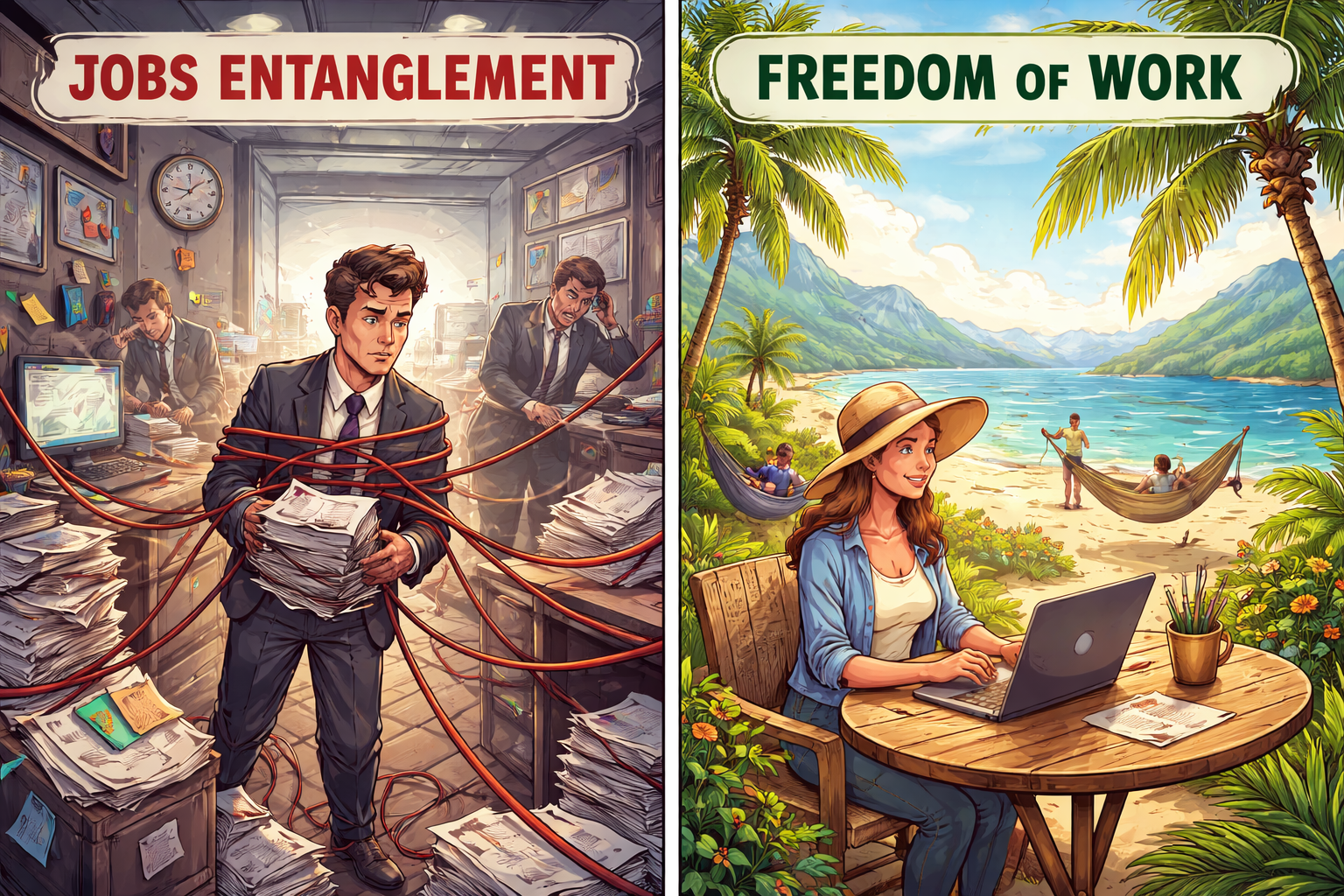
1. The Job Was Never the Point
Let’s start with a difficult truth:
Humans were never meant to be “jobs.”
Jobs are containers.
Titles are labels.
Employment is a distribution mechanism.
None of these were ever the point of work.
The point of work has always been:
-
contribution
-
creation
-
problem-solving
-
progress
But somewhere along the way, we confused the container for the content.
We began optimizing:
-
job descriptions instead of outcomes
-
headcount instead of capability
-
roles instead of results
And in doing so, we quietly constrained human potential.
2. Why Jobs Existed (And Why They’re Breaking Now)
Jobs made sense when:
-
work was repetitive
-
skills were narrow
-
change was slow
-
coordination was manual
A job bundled:
-
tasks
-
time
-
location
-
compensation
-
identity
into one manageable unit.
It was efficient — for the industrial era.
But in the knowledge + AI era, jobs have become misaligned with reality.
Today:
-
skills evolve faster than job descriptions
-
value is created in bursts, not shifts
-
people are multi-dimensional
-
work is global, asynchronous, and fluid
The job can’t keep up.
3. Employment Became a Bottleneck, Not a Benefit
Employment ties:
-
one human
-
to one company
-
in one geography
-
for one role
-
under one hierarchy
This creates massive inefficiencies:
-
Underutilized talent
-
Artificial scarcity
-
Burnout
-
Skill stagnation
-
Slow innovation
A brilliant engineer may deliver 4 hours of real value per day —
the rest is meetings, compliance, alignment, waiting.
Not because the person is inefficient —
but because the job structure is.
4. The Shift That Changes Everything: Outcomes as the Unit of Work
The future of work doesn’t revolve around jobs.
It revolves around outcomes.
Outcomes are:
-
discrete
-
measurable
-
composable
-
independent of time and location
An outcome is:
-
“Build this API”
-
“Design this workflow”
-
“Train this model”
-
“Ship this feature”
-
“Close this integration”
Outcomes don’t care:
-
where you live
-
what title you hold
-
who you report to
They care only about delivery.
This is the fundamental shift:
Jobs describe effort. Outcomes describe value.
5. Why Outcomes Need a New Structure (This Is Where VDCs Matter)
Outcomes alone are not enough.
If you remove jobs but don’t replace the structure, you get chaos.
This is why Virtual Delivery Centers (VDCs) are essential.
A VDC is:
a structured, governed, AI-orchestrated environment where outcomes are defined, assembled, delivered, validated, and paid for — without employment.
VDCs are not freelancing.
They are not outsourcing.
They are not temp staffing.
They are outcome-native organizations.
6. What a VDC Replaces (Explicitly)
A VDC replaces:
-
job descriptions
-
hiring cycles
-
employment contracts
-
reporting hierarchies
-
departmental silos
With:
-
outcome definitions
-
contributor graphs
-
AI coordination
-
transparent delivery
-
pay-for-results
This is not incremental change.
This is a structural replacement of employment itself.
7. Humans Don’t Lose Work — They Gain Freedom
In a VDC world:
-
a human is no longer “employed”
-
they are engaged
They can:
-
contribute to multiple VDCs simultaneously
-
work across industries
-
compound learning and income
-
choose outcomes aligned with skills and curiosity
Identity shifts from:
“I work for Company X”
to:
“Here’s what I’ve delivered.”
That is a healthier, more honest relationship with work.
8. AI Agents Make Outcome-First Work Possible
Here’s the key enabler:
Without AI, outcome-based work would collapse under coordination overhead.
AI agents now:
-
decompose outcomes
-
match contributors
-
track progress
-
enforce quality
-
handle governance
-
trigger payments
This is why jobs can finally disappear.
AI replaces:
-
managers
-
coordinators
-
schedulers
-
approvers
Not creators.
9. Companies Become Lean Cores + VDC Networks
Future companies will look like this:
-
Small strategic core (vision, product, culture)
-
Multiple VDCs for execution
-
AI agents for orchestration
-
Contributors instead of employees
This is how:
-
startups scale without hiring
-
enterprises stay agile
-
innovation speeds up
-
costs stay variable
The company becomes a network, not a pyramid.
10. Why This Unlocks Human Potential at Scale
This is the most important part.
VDCs unlock human potential because they remove:
-
geographic bias
-
credential bias
-
visa constraints
-
employment gatekeeping
A developer in Africa
A designer in Eastern Europe
A strategist in Southeast Asia
All participate equally.
The world moves from:
-
talent scarcity
to -
talent abundance
That is a civilizational upgrade.
11. Employment Was a Phase. Contribution Is the Destination.
Employment was a tool — not a destiny.
It helped humanity industrialize.
Now it’s holding humanity back.
Virtual Delivery Centers are the bridge:
-
from jobs → outcomes
-
from hierarchy → contribution
-
from control → creation
This is not anti-company.
It’s pro-progress.
12. Conclusion: The Job Is Ending. Work Is Evolving.
Jobs will not vanish overnight.
But they will slowly dissolve — replaced by:
-
outcome portfolios
-
contributor reputations
-
VDC participation
-
AI-orchestrated work
The future of work is not unemployment.
It is unbounded participation.
And Virtual Delivery Centers are the infrastructure that makes it real.
