 +91 990 880 2225
Leadership Was Designed for a Different World
Most leadership models in use today were designed for a world that no longer exists.
They assumed:
-
Work happened in one place
-
Decisions flowed through hierarchy
-
Coordination required proximity
-
And control ensured consistency.
In that world, leadership was largely about supervision, approval, and alignment through authority.
That world is gone.
Work is now:
-
Distributed
-
Asynchronous
-
Outcome-driven
-
And increasingly platformed.
When the structure changes, leadership must change with it, or become a bottleneck.
Why Org Charts Collapse but Leadership Does Not
One of the most misunderstood aspects of modern work is the idea that collapsing org charts means eliminating leadership.
That is not what is happening.
What is collapsing is positional authority, authority derived purely from where someone sits in a hierarchy.
What remains, and becomes more important, is contextual authority:
-
Carity of intent
-
Alignment of purpose
-
And trust in judgment.
Leadership does not disappear when org charts collapse.
It becomes more demanding.
The Death of Micromanagement Is Not Optional
In a platformed work model, especially in Virtual Delivery Centers (VDCs), micromanagement is not just ineffective.
It is dangerous.
When teams are:
-
Globally distributed
-
Operating across time zones
-
Delivering outcomes continuously
waiting for approvals from a single decision center introduces unacceptable latency.
Decisions delayed are opportunities lost.
Execution stalled is value destroyed.
Micromanagement dies not because it is disliked, but because it cannot survive the physics of modern work.
The Asynchronous Reality Leaders Must Accept
One of the least discussed shifts in leadership is time.
In global, platformed teams:
-
There is no single “working day”
-
No universal meeting hour
-
No shared pause for alignment.
If every tactical decision requires:
-
Escalation
-
Synchronous discussion
-
Or centralized approval
the system grinds to a halt.
Leadership must therefore move upstream.
Instead of deciding everything, leaders must shape how decisions are made.
The Question Leadership Must Answer Now
In this new environment, the central leadership question becomes:
“How do we ensure good decisions are made when we are not present?”
This is the wrong question if answered with control.
It is the right question if answered with design.
And this is where the 3E Principle becomes essential.
The 3E Principle: A Leadership Model for Platformed Work
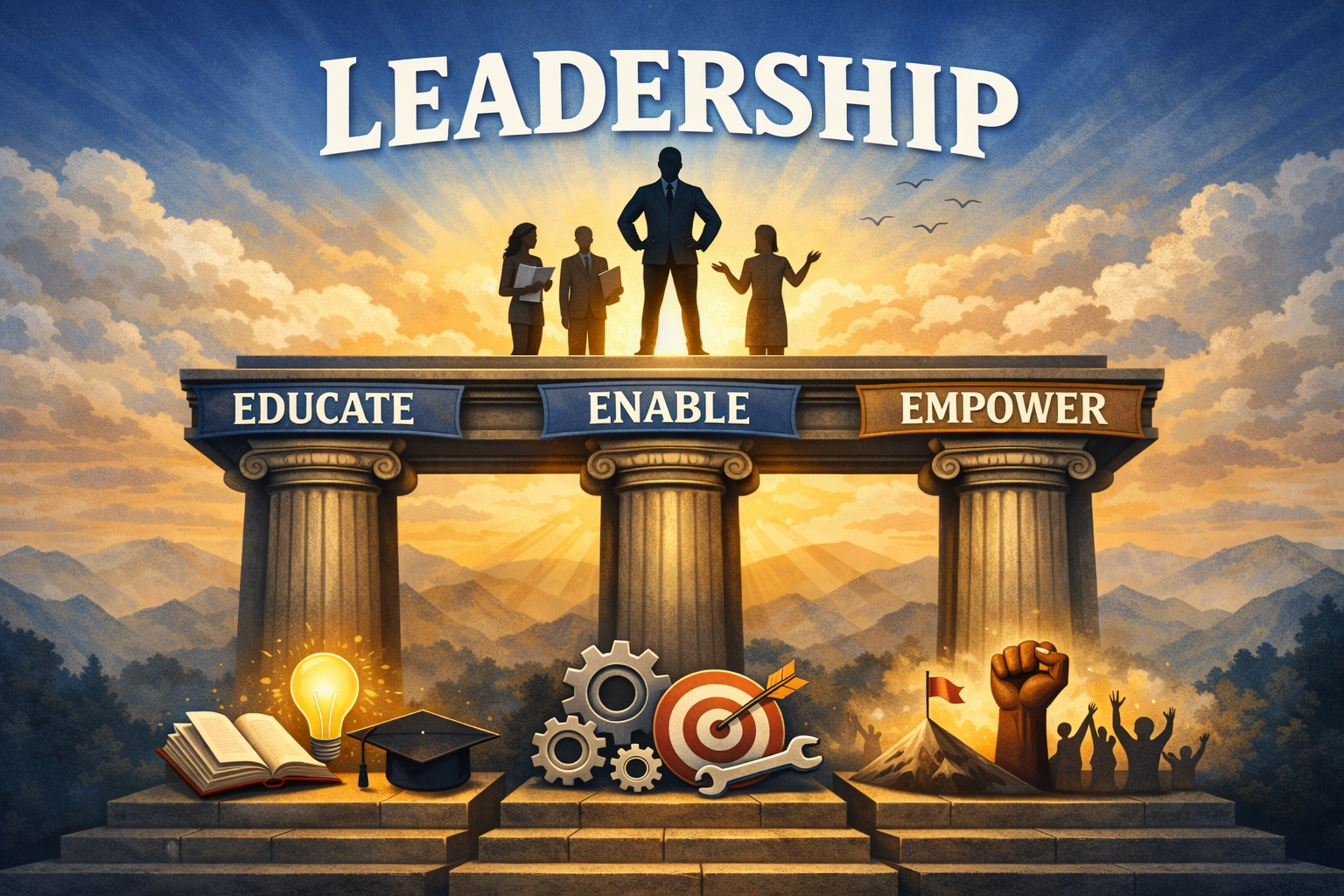
The 3E Principle is simple in articulation, but deep in implication:
Educate. Enable. Empower.
It is not a motivational slogan.
It is an operating system for leadership in distributed, outcome-based work.
Each “E” replaces a traditional management function that no longer scales.
Educate: Replacing Control with Context
In hierarchical organizations, alignment was enforced.
In platformed organizations, alignment must be understood.
To educate is not to train people on tasks.
It is to provide clarity on:
-
What we are doing
-
Why it matters
-
How it fits into the larger vision
-
And what success looks like.
When people understand the why and the where, they can make good decisions without supervision.
Education becomes the first layer of governance.
Why Education Must Be Continuous, Not Episodic
In fast-moving environments, context decays quickly.
Strategies evolve.
Priorities shift.
Constraints change.
Leaders must therefore treat education as a continuous broadcast, not an annual event.
In VDC-based models, this means:
-
Clear outcome definitions
-
Visible strategy artifacts
-
And shared understanding across global teams.
Without this, empowerment becomes chaos.
Enable: Replacing Permission with Capability
Traditional leadership often equated authority with permission:
-
Approval to proceed
-
Approval to spend
-
Approval to decide.
In the new work era, leadership must focus on capability, not permission.
To enable means:
-
Providing the right tools
-
Removing friction
-
Clarifying processes
-
And ensuring access to support.
People cannot execute well if the system slows them down.
Enablement is leadership expressed as infrastructure.
Tools, Processes, and Guardrails Matter More Than Instructions
In platformed work, instructions do not scale.
Systems do.
Leaders enable execution by:
-
Standardizing interfaces
-
Codifying best practices
-
Embedding compliance into workflows
-
And ensuring AI and tools assist rather than obstruct.
This allows teams to move fast without violating constraints.
Empower: Replacing Approval with Trust
Empowerment is the most misunderstood element of the 3E model.
It does not mean:
-
Absence of accountability
-
Unlimited autonomy
-
Or decision anarchy.
Empowerment means:
-
Authority to make tactical decisions
-
Within clearly understood boundaries
-
Aligned to outcomes.
It is trust designed into the system.
Why Empowerment Is Mandatory in Global Teams
In global VDCs and PODs, decision latency kills performance.
If a team in one timezone must wait for approval from another:
-
Momentum is lost
-
Accountability diffuses
-
And local context is ignored.
Empowerment ensures that:
-
Tactical decisions are taken where the work happens
-
Strategic decisions remain centralized
-
And execution flows continuously.
This separation is critical.
Strategic vs Tactical Decisions: The Critical Distinction
The 3E model relies on a clear distinction:
-
Strategic decisions:
-
Vision
-
Priorities
-
Architectural direction
-
Risk posture
These can wait. They require deliberation.
-
-
Tactical decisions:
-
Implementation choices
-
Execution sequencing
-
Day-to-day trade-offs
These must not wait.
-
Leaders who fail to make this distinction become bottlenecks.
Why E3 Works Better Than Command-and-Control
Command-and-control assumes:
-
Predictability
-
Stability
-
And limited autonomy.
Platformed work assumes:
-
Uncertainty
-
Speed
-
And distributed intelligence.
E3 aligns leadership with reality.
It shifts leaders from:
-
Decision-makers
to -
Decision-enablers.
That is not a loss of power.
It is a multiplication of impact.
Embedding E3 into the VDC Model
Virtual Delivery Centers (VDCs) are designed to operate on E3 principles by default.
They:
-
Educate participants through outcome clarity
-
Enable execution through shared tools and orchestration
-
Empower teams to deliver without waiting.
This is not accidental.
It is structural.
Without E3, VDCs would collapse under their own distribution.
Why This Is Hard for Traditional Leaders
Many leaders were promoted for:
-
Being the best problem solvers
-
Making the right calls
-
Having answers.
E3 leadership requires something different:
-
Designing environments where others solve problems
-
Resisting the urge to intervene
-
And trusting the system.
This is a psychological shift, not just a structural one.
What Happens When E3 Is Missing
When E3 is absent:
-
Teams hesitate
-
Decisions escalate unnecessarily
-
Work slows
-
And responsibility blurs.
When E3 is present:
-
Execution accelerates
-
Ownership increases
-
And leadership scales.
The difference is visible almost immediately.
Why E3 Is a Foundation, Not a Phase
E3 is not a transitional model.
It is not something organizations “try.”
It is a foundational requirement for any system where:
-
Work is modular
-
Participation is fluid
-
And execution is distributed.
As AI further reduces coordination costs, E3 becomes more necessary, not less.
The Leader’s New Role
In the new work era, leaders are not:
-
Supervisors of activity
-
Approvers of tasks
-
Or bottlenecks of decision.
They are:
-
Architects of context
-
Enablers of capability
-
And stewards of trust.
This is harder leadership, but also more meaningful.
Conclusion: Leadership That Scales with the Future
The collapse of org charts does not eliminate leadership.
It demands better leadership.
The 3E Principle: Educate, Enable, Empower — is not a soft ideal.
It is the only leadership model that survives when work is platformed, global, and outcome-driven.
Organizations that embed E3 will:
-
Move faster
-
Make better decisions
-
And unlock human potential at scale.
Those that don’t will find themselves trapped by the very hierarchies they once relied on.
In the new work era, leadership is no longer about control.
It is about making good decisions inevitable — even when you’re not there.
