 +91 990 880 2225
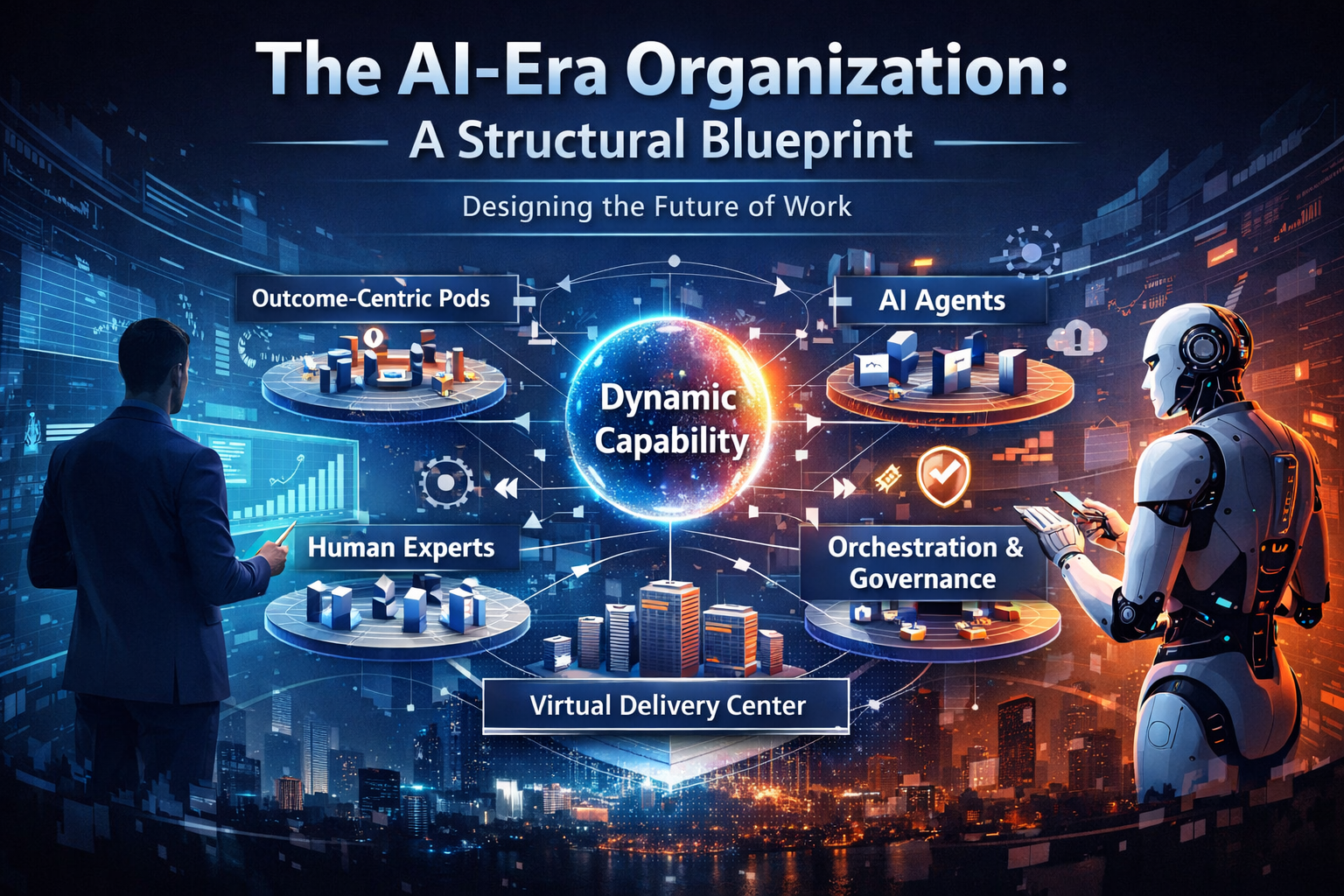
The Organizational Moment We Are Living Through
Every generation believes it is living through transformation.
But occasionally, there are moments when the structure of work itself begins to shift.
This is one of those moments.
Artificial intelligence is not just a new tool.
It is a new production layer.
It changes:
-
How work is performed,
-
Who performs it,
-
How fast it is delivered,
-
How it is governed,
-
and How organizations must be structured.
The confusion leaders feel today is not about whether AI matters.
It is about how to structure their organizations around it — without breaking what already works.
Why Traditional Org Design Is Straining
Traditional organizational design rests on a few assumptions:
-
Capacity equals people.
-
Roles are relatively stable.
-
Productivity changes gradually.
-
Departments are durable units.
AI disrupts all four.
Capacity is no longer proportional to people.
Roles are shifting faster than job descriptions can update.
Productivity improvements are uneven and non-linear.
Departments designed around static workflows are being challenged by dynamic capabilities.
The structure itself is misaligned with the new physics of work.
The Two Extremes That Won’t Work
Faced with this shift, organizations often swing toward one of two extremes.
Extreme 1: Overreaction.
Rapid automation. Sudden layoffs. Aggressive AI-first mandates. Cultural shock.
Extreme 2: Paralysis.
Pilot projects. Isolated experimentation. Minimal structural change. Hope that clarity emerges later.
Neither approach produces stability.
Overreaction destabilizes.
Paralysis calcifies.
What’s needed is structural evolution.
The Blueprint Starts With a Simple Reframe
Instead of asking:
“How do we use AI?”
Ask:
“How do we design an organization that continuously integrates evolving AI capabilities without structural shock?”
That shift in question is critical.
The goal is not AI adoption.
The goal is organizational adaptability.
The Four Pillars of the AI-Era Organization
The AI-era organization rests on four structural pillars:
-
Outcome-Centric Design
-
Dynamic Capability Composition
-
Embedded Orchestration
-
Governed Adaptability
Let’s unpack each.
Pillar One: Outcome-Centric Design
Industrial organizations were designed around functions.
Engineering.
Marketing.
Operations.
Finance.
AI-era organizations must increasingly be designed around outcomes.
Instead of asking, “Which department owns this?”
Ask, “What outcome are we trying to produce?”
When outcomes become the atomic unit:
-
Teams become modular.
-
Work becomes composable.
-
AI agents can be inserted into specific stages.
-
Human roles can shift without collapsing structure.
Outcome-centric design reduces dependency on static departments.
Pillar Two: Dynamic Capability Composition
Headcount is static.
Capability is dynamic.
The AI-era organization must be able to continuously rebalance:
-
Human expertise
-
AI agent contribution
-
Specialized external capability
This composition must evolve gradually.
Some work becomes AI-assisted.
Some remains human-led.
Some becomes hybrid.
The structure must allow this blend to change without requiring annual restructuring exercises.
Pillar Three: Embedded Orchestration
AI introduces power.
Power without orchestration introduces chaos.
Orchestration ensures:
-
Clear ownership
-
Transparent workflows
-
Defined handoffs
-
Decision latency reduction
-
Accountability traceability
In the AI-era organization, orchestration becomes a core competency — not an afterthought.
This is the difference between automation and transformation.
Pillar Four: Governed Adaptability
Adaptability without governance creates fragility.
AI integration raises questions about:
-
Compliance
-
Data security
-
Model accountability
-
Decision explainability
The blueprint requires guardrails embedded into workflows, not layered afterward.
Governance must travel with execution.
The Human Role in the AI-Era Organization
AI does not eliminate humans.
It shifts their center of gravity.
Humans increasingly focus on:
-
Architecture
-
Judgment
-
Strategy
-
Risk decisions
-
Creative problem framing
-
Ethical oversight
AI handles:
-
Structured throughput
-
Repetition
-
Pattern recognition
-
Draft generation
-
First-pass analysis
The blueprint must reflect this division.
From Fixed Departments to Modular Pods
Instead of large static departments, the AI-era organization favors modular execution units.
Small, outcome-driven pods composed of:
-
Business context owner
-
Product/architecture lead
-
Human contributors
-
Embedded AI agents
These pods can:
-
Scale up
-
Scale down
-
Evolve composition
-
Adjust AI-human ratio
Without destabilizing the broader organization.
Why the Virtual Delivery Center Model Fits This Blueprint
A Virtual Delivery Center (VDC) is not a vendor.
It is a structural container for modular execution.
It allows organizations to:
-
Blend human and AI capability
-
Scale without fixed headcount shock
-
Maintain governance
-
Adjust continuously
The VDC model operationalizes the blueprint.
It makes adaptability structural, not theoretical.
Moving Gradually, Not Suddenly
One of the greatest fears leaders have is destabilization.
They fear:
-
Sudden layoffs
-
Morale collapse
-
Public backlash
-
Talent flight
The blueprint rejects sudden shifts.
Instead, it proposes:
-
Gradual AI integration
-
Gradual workload rebalance
-
Gradual capability measurement
-
Gradual headcount elasticity
Evolution, not revolution.
The New Organizational Health Metric
In this blueprint, organizational health is measured by:
-
Outcome throughput
-
Decision latency
-
AI-human productivity multiplier
-
Capability adaptability
-
Governance robustness
Not by:
-
Total headcount
-
Department size
-
Office footprint
Strength becomes systemic, not numerical.
The Leadership Shift Required
Leaders must shift from:
Control → Context
Approval → Enablement
Headcount growth → Capability growth
Static planning → Dynamic orchestration
This requires psychological maturity.
It requires comfort with evolution instead of fixed identity.
Why This Blueprint Is Inevitable
Markets are accelerating.
Technology is compounding.
AI capability is evolving monthly.
Organizations that cling to static structures will oscillate between:
-
Overhiring and layoffs
-
Automation hype and retreat
-
Cultural instability
Organizations that adopt structural adaptability will move calmly.
The shift is not ideological.
It is economic.
The Calm Future
The AI-era organization is not chaotic.
It is not headcount-free.
It is not human-free.
It is composable.
Measurable.
Orchestrated.
Governed.
It adapts quietly as technology evolves.
It avoids violent swings.
It scales without noise.
The Final Reframe
The question leaders should ask is no longer:
“How many people should we hire?”
Nor:
“How much AI should we adopt?”
The question is:
“How do we design an organization that evolves as capability evolves?”
That is the structural blueprint.
Conclusion
The AI-era organization is not defined by tools.
It is defined by structure.
Outcome-centric.
Dynamically composed.
Orchestrated.
Governed.
Adaptable.
The companies that embrace this blueprint will not be disrupted by AI.
They will be stabilized by it.
