 +91 990 880 2225
1. Every Leap in Civilization Was a Coordination Breakthrough
Human progress has never been limited by intelligence.
It has always been limited by coordination.
We had ideas long before we had cities.
We had tools long before we had supply chains.
We had knowledge long before we had institutions.
Civilizations advanced not when humans became smarter —
but when humans learned to coordinate at scale.
-
Writing coordinated memory
-
Money coordinated trust
-
Roads coordinated movement
-
Electricity coordinated energy
-
The internet coordinated information
Each breakthrough wasn’t a product.
It was infrastructure.
Now humanity stands at the edge of the next coordination leap.
And this time, the thing being coordinated is human capability itself.
2. The Greatest Inefficiency in the World Today Isn’t Capital — It’s Talent
Capital flows freely across borders.
Information flows instantly.
Goods move globally.
But human talent remains artificially constrained.
Locked behind:
-
geography
-
visas
-
employment contracts
-
organizational boundaries
-
credential filters
-
hiring bottlenecks
This creates a tragic imbalance:
On one side:
-
billions of capable humans underutilized
On the other:
-
companies claiming “talent shortages”
This is not a skills problem.
It’s a coordination failure.
Humanity has never lacked talent.
It has lacked a global system to engage it.
3. Employment Was a Local Solution to a Global Problem
Employment emerged as a coordination mechanism for a local world.
It assumed:
-
work happens in one place
-
for one employer
-
during fixed hours
-
under a stable hierarchy
That model worked when:
-
economies were national
-
companies were physical
-
communication was slow
-
trust required proximity
But the world outgrew employment.
We globalized:
-
markets
-
supply chains
-
information
-
capital
Yet we left work trapped in 20th-century containers.
The result is friction everywhere:
-
hiring delays
-
migration crises
-
brain drain
-
burnout
-
inequality
-
wasted potential
Employment didn’t fail morally.
It failed structurally.
4. The Internet Gave Us a Global Brain — But Not Global Hands
The internet connected minds.
Ideas travel instantly.
Knowledge is shared freely.
Learning is democratized.
But execution remained siloed.
Why?
Because execution requires:
-
trust
-
accountability
-
governance
-
coordination
The internet solved communication.
It didn’t solve organized contribution.
Until now.
5. Virtual Delivery Centers (VDCs): The Missing Layer
This is where Virtual Delivery Centers (VDCs) change everything.
A VDC is not a company.
It’s not a team.
It’s not outsourcing.
A VDC is a coordination primitive.
A VDC is a structured, AI-orchestrated environment where humans contribute to outcomes — independent of location, employment, or hierarchy.
VDCs do for work what:
-
the internet did for information
-
cloud computing did for infrastructure
They turn human capability into a globally addressable resource.
6. From Companies to Cells: A New Organizational Metaphor
Industrial organizations were pyramids.
Digital organizations became platforms.
The next form is cellular.
VDCs function like biological cells:
-
self-contained
-
purpose-driven
-
temporary or persistent
-
interoperable
Companies no longer scale by hiring.
They scale by spawning VDCs.
Each VDC:
-
assembles talent
-
delivers outcomes
-
dissolves or evolves
This is not chaos.
It is living order.
7. The Borderless Human Grid Emerges
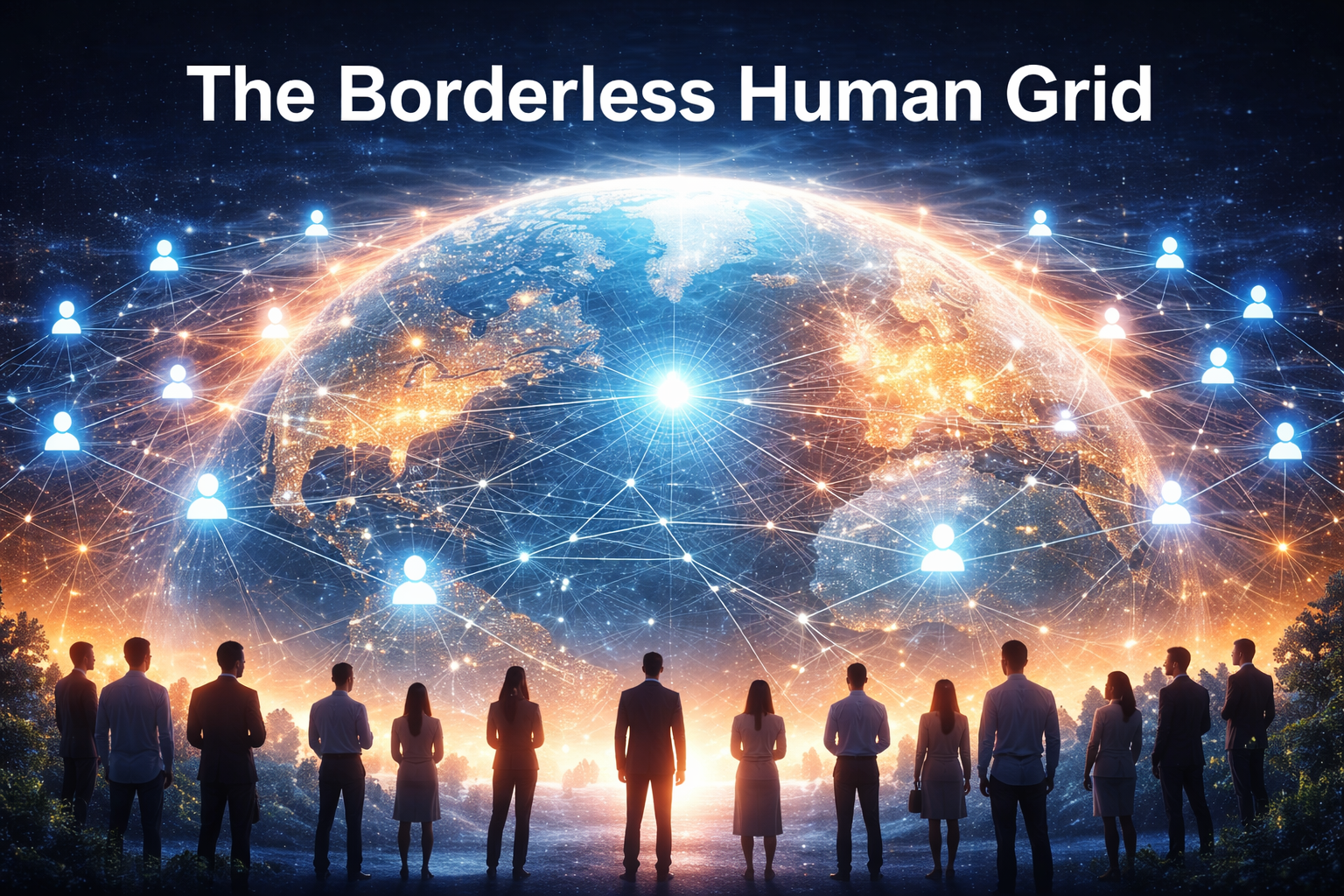
When VDCs interconnect, something larger appears:
The Borderless Human Grid
A planetary network where:
-
work is modular
-
contribution is fluid
-
identity is reputation-based
-
opportunity is global
In this grid:
-
a researcher in Kenya
-
a designer in Poland
-
a product thinker in India
-
an AI agent in the cloud
collaborate seamlessly — not as employees, but as contributors.
The grid doesn’t care:
-
where you live
-
who you work for
-
what passport you hold
It only cares:
-
what you can contribute
-
what you deliver
This is meritocracy at civilizational scale.
8. AI Agents: The Nervous System of the Grid
A human grid cannot function without automation.
AI agents provide the nervous system:
-
matching outcomes to contributors
-
tracking delivery
-
enforcing governance
-
resolving dependencies
-
allocating rewards
AI doesn’t dominate the grid.
It stabilizes it.
Humans remain the creators.
AI ensures coherence.
This is why AI doesn’t replace humans.
It enables humanity to coordinate itself.
9. Why This Changes Everything (Economically)
When human contribution becomes globally accessible:
-
productivity explodes
-
innovation accelerates
-
barriers collapse
Countries stop competing for jobs.
They compete to enable contribution.
Economic power shifts from:
-
headquarters
-
employment centers
-
visa regimes
to:
-
platforms
-
networks
-
coordination layers
GDP becomes less about where companies are registered —
and more about how effectively a society plugs into the human grid.
10. Why This Changes Everything (Socially)
Work is more than income.
It’s dignity.
It’s participation.
It’s meaning.
When billions are excluded from meaningful work, societies fracture.
The Borderless Human Grid:
-
restores participation
-
reduces forced migration
-
decentralizes opportunity
-
stabilizes communities
People don’t need to leave home to access global work.
Global work comes to them.
That is how inequality actually reduces — not through aid, but through access.
11. From Scarcity to Abundance — A Psychological Shift
For centuries, work was scarce.
Jobs were limited.
Opportunity was zero-sum.
The grid flips this mindset.
Outcomes are abundant.
Problems are infinite.
Contribution scales.
Humans move from:
-
competition → collaboration
-
hoarding → sharing
-
employment anxiety → creative agency
This is not utopian.
It’s structural.
12. AiDOOS and the Role of Platforms
Platforms like AiDOOS are not marketplaces.
They are coordination engines.
They provide:
-
VDC creation
-
AI orchestration
-
governance frameworks
-
outcome ledgers
-
reputation systems
They are to human work what:
-
TCP/IP was to the internet
-
AWS was to computing
Invisible, foundational, indispensable.
13. What Happens to Companies in This World?
Companies don’t disappear.
They transform.
They become:
-
mission definers
-
outcome aggregators
-
value distributors
The company becomes the intent layer.
The VDCs become the execution layer.
The human grid becomes the capability layer.
This separation is what allows scale without bloat.
14. The Biggest Shift: Identity
The most profound change isn’t economic.
It’s personal.
People stop asking:
“Where do you work?”
They start asking:
“What are you working on?”
Identity shifts from employer to impact.
Resumes fade.
Outcome histories emerge.
This is how humans reclaim agency over their lives.
15. This Is Not the End of Work — It’s the Beginning of Participation
The fear narrative says:
“AI will take jobs.”
The reality is more hopeful:
AI and VDCs will make work accessible to more humans than ever before.
Work doesn’t disappear.
It unlocks.
Humanity moves from:
-
employment → participation
-
hierarchy → contribution
-
borders → networks
That is not disruption.
That is evolution.
16. Conclusion: The Grid Is Inevitable
Every coordination breakthrough eventually becomes invisible.
We don’t think about roads.
We don’t think about electricity.
We don’t think about the internet.
In time, we won’t think about VDCs.
We’ll simply live in a world where:
-
anyone can contribute
-
from anywhere
-
to anything meaningful
The Borderless Human Grid is not a prediction.
It’s a necessity.
And like all necessary systems,
it will arrive —
not because it is ideal,
but because everything else is too inefficient to survive.
