 +91 990 880 2225
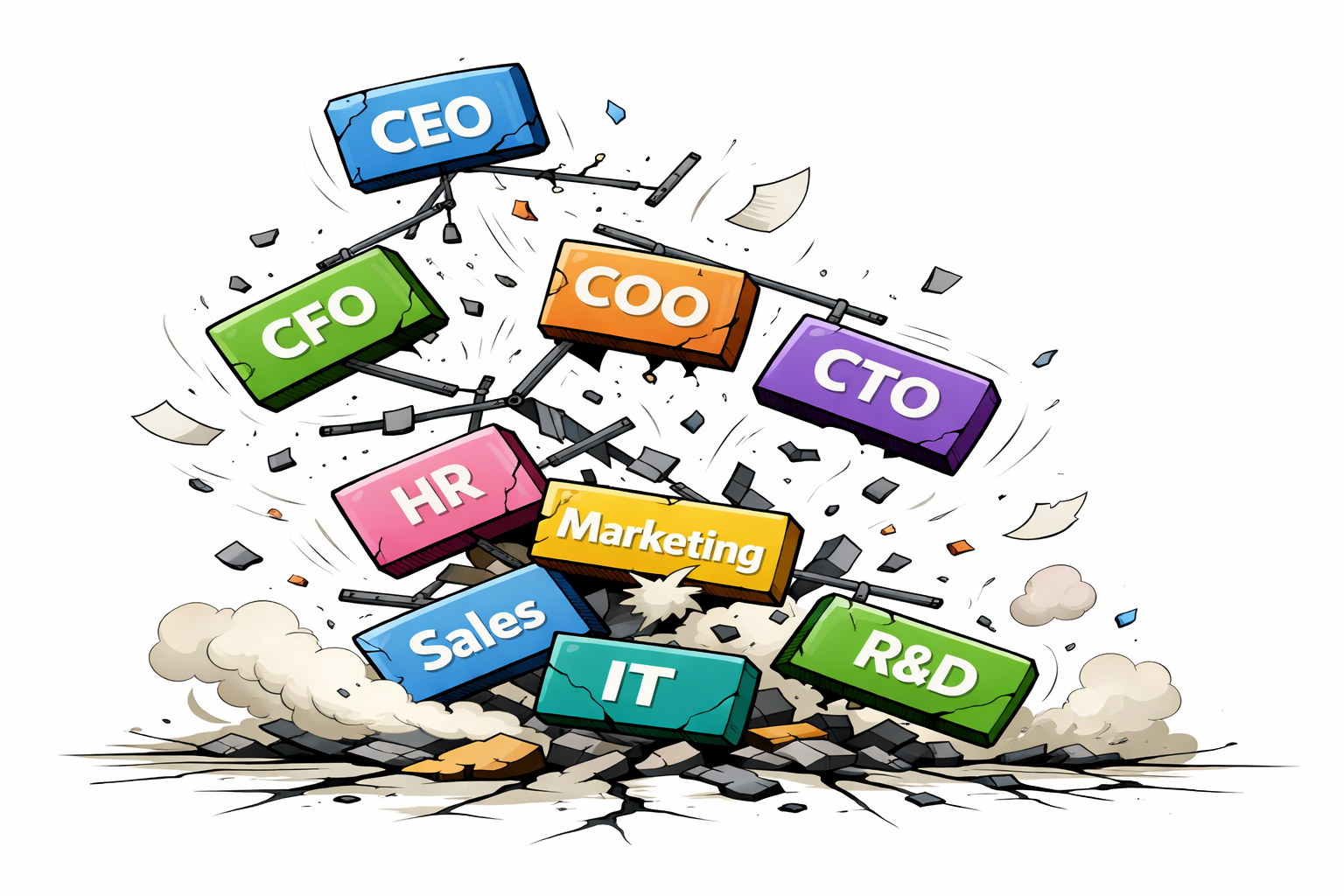
The Most Invisible Assumption in Modern Work
There is a diagram so familiar that we almost never question it.
Boxes.
Lines.
Titles stacked from top to bottom.
Executive at the top.
Managers in the middle.
Workers at the bottom.
We call it an org chart — and we treat it as natural, inevitable, even necessary.
But what if it isn’t?
What if the org chart was never a feature of good work design —
but a bug introduced by technological limitations of the past?
What if hierarchy wasn’t chosen because it was optimal —
but because it was the only thing that worked at the time?
And what if the very thing we now defend as “structure”
has quietly become the biggest bottleneck to human progress?
Org Charts Were Invented to Solve One Problem: Latency
To understand why org charts exist, we need to rewind — not decades, but centuries.
Before computers.
Before the internet.
Before real-time communication.
Information moved slowly.
Decisions traveled even slower.
If a factory owner wanted to know what was happening on the floor,
they couldn’t see dashboards.
They couldn’t query systems.
They couldn’t get live metrics.
They needed people to relay information.
Supervisors.
Foremen.
Managers.
Directors.
Hierarchy emerged as a communication technology.
Org charts were not about power.
They were about latency management.
When information is slow:
-
you centralize decisions
-
you create reporting layers
-
you build chains of command
Hierarchy wasn’t wisdom.
It was a workaround.
The Industrial Logic: Control Before Creativity
The industrial era optimized for three things:
-
Predictability
-
Repeatability
-
Control
Factories didn’t need creativity.
They needed consistency.
So work was broken into:
-
roles
-
tasks
-
shifts
Humans were interchangeable components in a machine.
Hierarchy made sense because:
-
output was linear
-
change was slow
-
deviation was dangerous
The org chart ensured:
-
compliance over curiosity
-
obedience over insight
-
efficiency over evolution
And for a while, it worked.
The bug didn’t reveal itself — because the environment didn’t change.
The Knowledge Era Exposed the First Crack
Then knowledge work arrived.
Software.
Design.
Research.
Strategy.
Suddenly:
-
value lived in people’s heads
-
ideas mattered more than execution
-
creativity beat repetition
But we kept the same structure.
We forced knowledge workers into factory-era hierarchies.
The result?
-
managers managing work they didn’t fully understand
-
decision-makers far from the actual problem
-
endless meetings to compensate for lost context
This is where the org chart began to malfunction.
Hierarchy slowed thinking.
Layers distorted information.
Approvals killed momentum.
But we tolerated it — because there was still no alternative.
The Internet Should Have Killed Org Charts (But Didn’t)
The internet did something radical:
-
it collapsed communication latency to near-zero
Email.
Chat.
Shared docs.
Real-time collaboration.
Information no longer needed carriers.
In theory, hierarchy should have dissolved.
But it didn’t.
Why?
Because communication was only half the problem.
Execution still required:
-
coordination
-
tracking
-
enforcement
-
governance
So humans stayed in the loop as coordinators.
Middle management survived — not because it was ideal,
but because it was still necessary.
Until now.
The Hidden Cost of Hierarchy
Let’s name the real cost of org charts — the cost we normalize but never measure.
Hierarchy creates:
-
delay (decisions move up and down)
-
distortion (information changes as it travels)
-
disengagement (people stop thinking, start complying)
-
politics (power becomes positional, not contributive)
-
waste (meetings exist to maintain structure, not deliver outcomes)
Most modern dysfunction is not cultural.
It is structural.
We don’t have a “people problem.”
We have an architecture problem.
Org Charts Scale Control — Not Intelligence
Here’s the core flaw.
Org charts scale authority, not intelligence.
They assume:
-
decisions should be centralized
-
judgment should move upward
-
execution should move downward
But intelligence doesn’t scale vertically.
It scales laterally.
Ideas emerge at the edges.
Insight lives close to the problem.
Creativity thrives in autonomy.
Hierarchy inverts this natural flow.
The people who know the most often decide the least.
That’s not a people failure.
That’s a design bug.
Why We Kept Defending the Bug
If org charts are so flawed, why did we defend them for so long?
Because until recently, the alternative didn’t exist.
To remove hierarchy, you need:
-
real-time visibility
-
automated coordination
-
unbiased enforcement
-
continuous feedback loops
Humans were doing this manually — badly, expensively, and inconsistently.
So we accepted hierarchy as “the best we can do.”
That excuse is gone.
AI Didn’t Arrive to Replace Workers — It Arrived to Fix Coordination
This is the inflection point.
AI agents don’t think like humans.
They don’t feel like humans.
They don’t create like humans.
But they do something humans are terrible at:
coordination at scale.
AI can:
-
track thousands of tasks simultaneously
-
monitor progress in real time
-
detect bottlenecks instantly
-
enforce rules consistently
-
surface insights without bias
This is exactly what org charts were meant to do — and failed at.
AI doesn’t replace talent.
It replaces the need for layers above talent.
From Hierarchies to Outcome Graphs
When coordination becomes automated, structure changes.
Instead of:
-
static roles
-
permanent teams
-
reporting lines
We move to:
-
dynamic outcomes
-
temporary assemblies
-
contribution-based participation
Work organizes around what needs to be done, not who reports to whom.
This creates outcome graphs — not org charts.
People connect to missions.
AI orchestrates execution.
Governance is embedded, not enforced.
This is not chaos.
It’s higher-order order.
Virtual Delivery Centers: What Work Looks Like Without Org Charts
This is where Virtual Delivery Centers (VDCs) emerge — not as a trend, but as a necessity.
A VDC is what an organization becomes after hierarchy collapses.
In a VDC:
-
there are no titles
-
no managers
-
no reporting chains
There are:
-
outcomes
-
contributors
-
AI agents coordinating flow
-
transparent delivery metrics
Humans do the work.
AI manages the structure.
The org chart disappears — not by force, but by irrelevance.
The Middle Layer Isn’t Evil — It’s Obsolete
This must be said carefully.
Middle management didn’t fail.
It was outpaced.
Managers existed because:
-
someone had to coordinate
-
someone had to report
-
someone had to enforce standards
AI now does this better, faster, cheaper, and without ego.
This is not about eliminating people.
It’s about freeing them from non-human work.
Many managers will become:
-
contributors
-
strategists
-
mentors
-
builders
But the layer disappears.
Why Flat Doesn’t Mean Chaotic
Critics will say:
“Without hierarchy, everything falls apart.”
This fear confuses control with coordination.
Control requires hierarchy.
Coordination does not.
The internet has no org chart.
Yet it functions.
Open-source communities have no hierarchy.
Yet they build world-class systems.
Nature itself has no org chart.
Yet it produces extraordinary order.
The future of work aligns with nature — not factories.
The End of the Org Chart Is the Beginning of Real Work
When hierarchy collapses:
-
people stop performing for managers
-
meetings disappear
-
work speeds up
-
accountability becomes visible
-
talent resurfaces
This is not a productivity gain.
It’s a human gain.
People regain agency.
Work regains meaning.
Organizations regain adaptability.
Conclusion: The Bug Is Finally Being Fixed
Org charts were not a moral failure.
They were a technical workaround.
They solved yesterday’s problem.
They are now today’s bottleneck.
AI didn’t arrive to replace humans.
It arrived to remove the scaffolding we built around them.
The org chart was never the future of work.
It was a temporary patch.
That patch is now being removed.
What replaces it isn’t chaos.
It’s something better:
-
outcome-driven work
-
AI-orchestrated coordination
-
human creativity at full capacity
The bug is being fixed.
And for the first time in history,
work is finally being designed around humans — not around control.
