 +91 990 880 2225
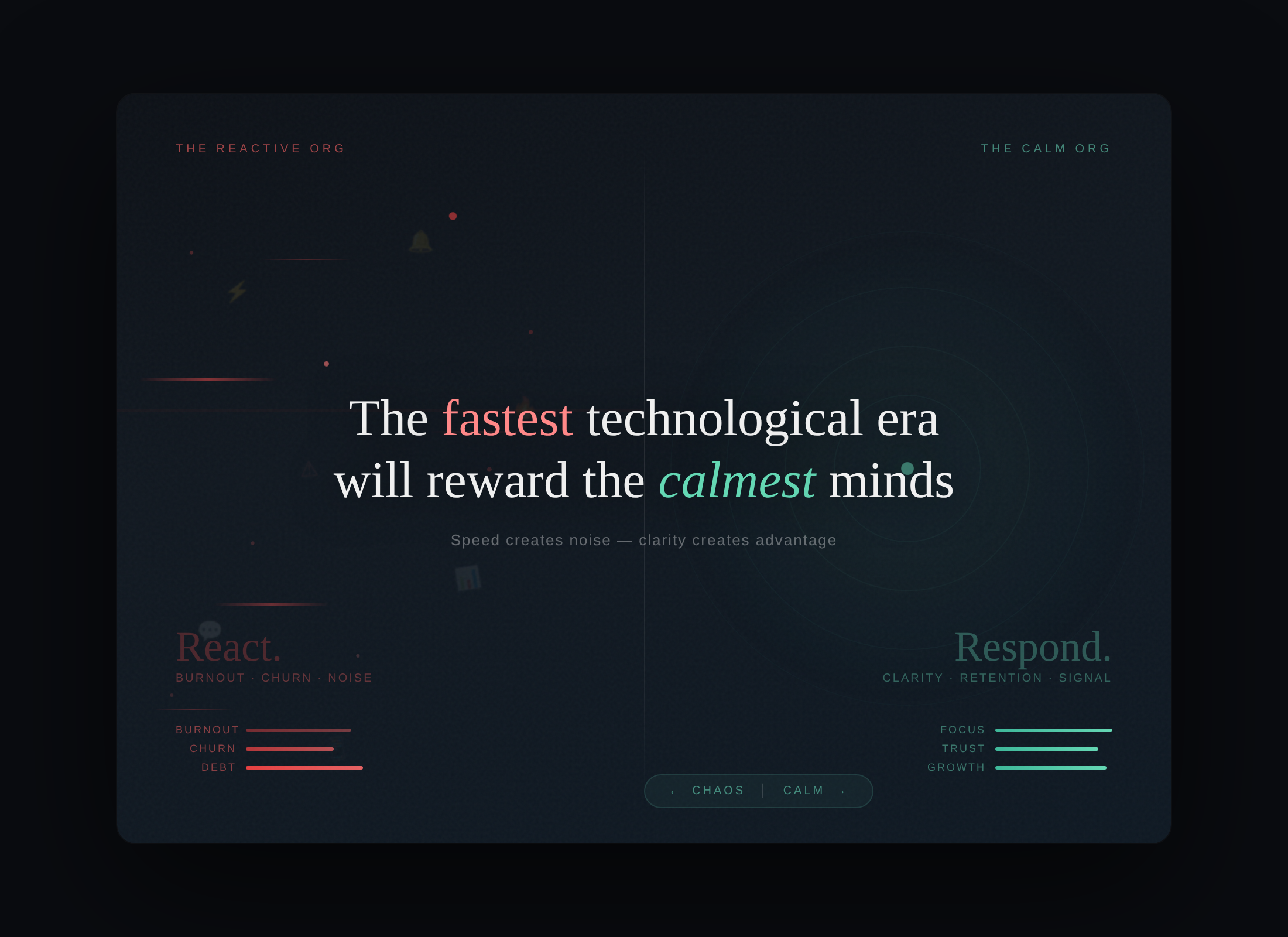
There is a strange paradox unfolding in the modern economy.
Everything around us is accelerating.
Technology evolves faster than institutions can adapt.
Software cycles compress from years to months, from months to weeks.
Artificial intelligence capabilities improve with every new model release.
Markets react instantly to information.
Startups scale globally in a matter of years.
Acceleration has become the defining feature of our time.
Yet in the middle of this technological velocity, leaders are searching for something that feels almost contradictory:
Stability.
Not stagnation.
Not resistance to change.
But the ability to operate calmly, predictably, and reliably while the environment moves faster every year.
This tension — between acceleration outside and stability inside — may be the defining leadership challenge of the AI era.
The Illusion That Speed Alone Wins
Many organizations react to acceleration by trying to move faster in every dimension.
Faster hiring.
Faster product launches.
Faster decision cycles.
Faster experimentation.
Speed becomes a strategy.
But speed without structure often produces chaos.
Teams burn out.
Decisions become reactive instead of thoughtful.
Technical debt accumulates.
Cultural cohesion erodes.
What begins as velocity slowly turns into volatility.
And volatility is not the same thing as progress.
Acceleration Is Structural Now
The acceleration we are witnessing is not temporary.
It is not a business cycle.
It is the natural consequence of compounding technologies.
Artificial intelligence improves through data and compute feedback loops.
Cloud infrastructure reduces friction to scale.
Global connectivity distributes ideas instantly.
Each layer reinforces the next.
Which means the baseline pace of change will likely continue increasing, not stabilizing.
If acceleration is structural, then organizations cannot simply “wait it out.”
They must design themselves to live inside it.
Why Traditional Structures Struggle
Most organizational structures were designed in a slower era.
Departments were stable for decades.
Roles evolved gradually.
Planning cycles stretched across years.
The structure assumed that change would occur — but slowly enough for leadership to adapt through periodic adjustments.
Acceleration breaks this assumption.
When technology evolves every quarter, static structures struggle to keep up.
Processes become bottlenecks.
Decision layers slow execution.
Hierarchies delay response.
The organization becomes the slowest component in a fast-moving system.
The Real Source of Stability
In the industrial age, stability came from rigidity.
Factories ran predictable workflows.
Departments had fixed responsibilities.
Headcount remained relatively constant.
Rigid systems could remain stable because the environment was stable.
In the digital age, the opposite is true.
Stability now comes from adaptability.
Organizations must be flexible enough to evolve continuously without collapsing under their own complexity.
The paradox is simple:
The more adaptive the structure, the more stable the organization becomes.
Calm Systems in Fast Environments
Consider how the internet itself operates.
Billions of devices connect, disconnect, and exchange data constantly.
Yet the underlying protocols remain stable.
The network absorbs change without collapsing.
The same principle applies to organizations in the AI era.
The goal is not to freeze the environment.
The goal is to design systems that can absorb change without destabilizing.
Humans and AI in the Same System
Artificial intelligence introduces a new dimension of acceleration.
Tasks that once required hours can now be completed in minutes.
Research, documentation, coding assistance, and data analysis are increasingly augmented by machines.
But AI also introduces uncertainty.
Capabilities evolve rapidly.
Best practices change quickly.
Tools improve faster than organizational training cycles.
Leaders therefore face a new question:
How do we integrate AI without constantly reorganizing the company?
The answer lies not in tools, but in structure.
Stability Through Modularity
One of the most powerful ways to maintain stability in fast environments is modular design.
Modular systems isolate change.
Instead of disrupting the entire organization when something evolves, change occurs inside contained units.
In software architecture, this principle allows complex systems to evolve safely.
The same principle applies to organizations.
Smaller execution units — often called pods or teams — allow adaptation without systemic shock.
If one unit changes its tools, workflows, or AI integration, the rest of the organization continues functioning smoothly.
Orchestration Becomes the Core Capability
As systems become modular, coordination becomes more important than control.
Traditional management focused on supervising individuals.
AI-era leadership focuses on orchestrating systems.
Orchestration ensures that:
-
teams align around outcomes,
-
AI tools integrate safely,
-
workflows remain transparent,
-
governance remains intact.
Without orchestration, modularity becomes fragmentation.
With orchestration, modularity becomes resilience.
The Quiet Advantage of Calm Organizations
In fast markets, calm organizations gain an unexpected advantage.
They avoid overreaction.
They do not chase every new technology impulsively.
They do not restructure every quarter.
They do not panic when tools evolve.
Instead, they evolve gradually.
They integrate new capabilities thoughtfully.
And because their structure absorbs change, they maintain operational continuity.
While competitors oscillate between hype and retrenchment, calm organizations simply continue delivering.
Over time, consistency compounds.
Leadership in an Accelerating World
Acceleration places psychological pressure on leaders.
Every breakthrough seems urgent.
Every innovation appears existential.
But leaders must distinguish between capability evolution and organizational instability.
Technology can evolve rapidly while organizations evolve deliberately.
The fastest companies are not always the ones that react first.
They are the ones whose systems allow them to move confidently when the direction becomes clear.
Designing for Long-Term Adaptability
The most resilient organizations design themselves around a few enduring principles.
They focus on outcomes rather than rigid departments.
They build modular execution structures.
They integrate human expertise with AI capability gradually.
They embed governance into workflows instead of adding it afterward.
These principles create a system that adapts continuously without losing coherence.
Why the Future Rewards Stability
As AI accelerates the pace of innovation, volatility will increase across industries.
New tools will appear weekly.
Capabilities will shift unexpectedly.
Market expectations will evolve faster than before.
Organizations that chase acceleration blindly will exhaust themselves.
Organizations that design for adaptability will remain steady.
And in a world defined by constant motion, steadiness becomes a strategic advantage.
The Final Paradox
Acceleration is inevitable.
Stability is optional.
But the organizations that thrive will be the ones that reconcile both.
They will move within the current of technological change without being thrown off course by it.
They will adopt new capabilities without destabilizing their foundations.
They will remain calm while the world moves faster.
In the AI era, the winners will not be those who move the fastest.
They will be those who build organizations capable of moving fast without losing balance.
